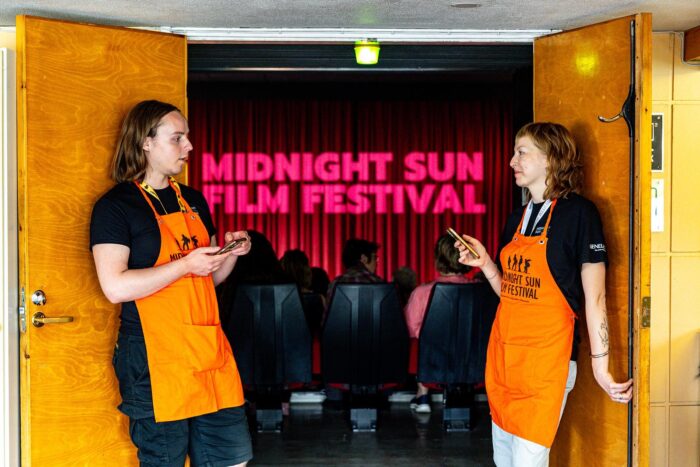
The first day of the film festival kicked off with a discussion at Kitisen Keitaa, about the importance of archive film in film education. The discussion was attended by film educator and Kokkola Film Festival Executive Director Kaisa Kukkola, Espoo Ciné Executive Director Tytti Rantanen, School Cinema specialist Saara Konttinen, Sodankylä Municipality Cultural Coordinator Anna Yliniemi and AFFN (Archive Film Festival Network) Visual Designer and Expert David Huspenina.
Kukkola highlighted the alternative ways of depicting and viewing the world offered by film education. In Yliniemi’s words: when film changes you from within, the educational perspective is fulfilled, not only for children and young people, but also for adults. Konttinen emphasized the possibilities of connecting film to the central themes of different subjects, and at the same time pointed out the importance of multiliteracy in a comprehensive understanding of the art form, as film moves in the areas of art as well as media and communication.
The panelists recognized the importance of archival films in developing film literacy and cultural and historical understanding. At the same time, they hoped for a greater role of archival films in film education. One challenge to the wider use of archival films in teaching is the difference in background of the students in the genre. Due to their wide visibility, new films are, in Kukkola´s words, “mentally more accessible”.
The first festival screening at the Lapinsuu Cinema was the wild British old age drama Queen at Sea. Directed by the long-time director Lance Hammer, the film stars Juliette Binoche, as well as older British actors Tom Courtenay and Anna Calder-Marshall. The film raises difficult questions about the rights and the treatment of elderly people with dementia. The film was introduced by Program Director Timo Malmi.
In the afternoon, the Lapinsuu audience was eagerly awaiting a surprise Italian film, which, along with its guest stars, remained a secret until the very beginning of the film. The surprise guest was revealed to be actress Dominique Sanda, who also visited the film festival last year. The screening featured the recent film Vita Mia (2025), directed by Edoardo Winspere, in which Sanda plays a Hungarian duchess with a turbulent past. The melancholic film and Sanda received a standing ovation from the audience.
In the afternoon, the Big Tent hosted three Finnish short films: Risto-Pekka Blom’s allegorical, brutal story Too Blue a Sky (2026), Jan Ljäks’s gripping Picnic Light Invisible to the Human Eye (2026), about the genocide in Gaza, and Yasmin Najjar’s TJ28 (28 Days Left), based on her own experiences in the army. The short films evoked both thoughts and emotions, and during the final credits, small sobs could be heard among the audience.
The opening screening of Abderrahmane Sissako’s Timbuktu in Lapinsuu drew a full audience. The film depicted the tension that arises between an extremist Islamic armed group and the local community in Mali in 2012. The visually beautiful film approached a difficult subject with sensitivity, and received massive applause from the audience.
The afternoon Master Class introduced the audience, who had taken refuge in the summer rain, to the festival’s first musical film, Helmut Käutner’s daring satire The Dream of Lieschen Mueller (1961), which film expert Olaf Möller, who achieved cult status in Sodankylä, had chosen to be the first film in his series.
The evening culminated in a sold-out screening of Smithereens (1982), by festival guest Susan Seidelman. Seidelman told the enthusiastic audience about the filming of the film in 1980’s New York, and how, through a series of miraculous coincidences, the film ended up at the Cannes Film Festival as the first American Indie film.