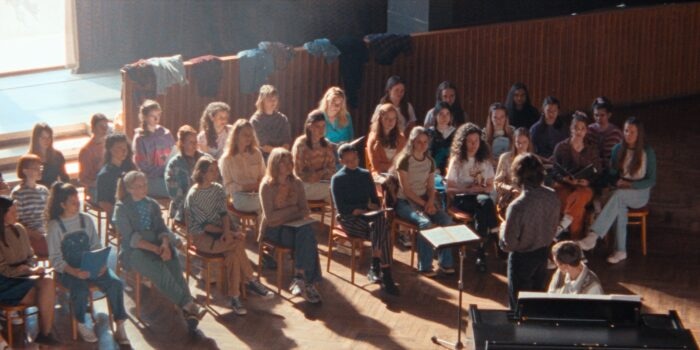
The teenage girls are in perfect harmony – but only when they’re singing. The rest of the time, the members of this otherwise respected choir smoke cigarettes, steal each other’s towels in the middle of a shower, and form cliques just like any other teenagers. Karolína, the thirteen-year-old protagonist of this Czech drama, joins a choir in her older sister Lucie’s footsteps, and suddenly she is part of a secret society teetering between childhood and adulthood.
Ondřej Provazník’s sensitive and nuanced drama is heartbreakingly beautiful, as if infusing its images with the enchantment and wonder of the teenage years – the very same that is reflected in the eyes of Katerina Falbrová, who plays Karolína. In Lukáš Milota’s handheld camera images, even the backgrounds come to life.
A counterpoint is found in danger: in the indeterminate debris and traces of temporary dwellings in the nearby forest and in Vítek (Juraj Loj), the choir leader, who keeps the teenagers constantly competing for both his attention and the coveted spots on the US tour. The adult man goes to the sauna with the choir members and pours Karolína a sip of wine from his bottle. It is the 1980s, and nobody finds it strange.
In the distant background of the film lies the true story about a girls’ choir in Prague whose director was sentenced to prison in the 2000s for sexual abuse. Provazník, however, does not lean on indignation but on the coming-of-age story of a pre-teen, during which a sense of sadness settles into her wondering eyes.
Prague-born ONDŘEJ PROVAZNÍK (b. 1978) studied journalism at university and screenwriting at film school. Before embarking on his film career, he worked in the culture section of the daily newspaper Lidové noviny and as a director on the current affairs TV programme Kosmopolis. Since then, Provazník has made television programmes, documentaries and fiction films, often in collaboration with Martin Dušek. Broken Voices is Provazník’s first feature-length drama, for which he is solely responsible for both the screenplay and the direction. The film won the FIPRESCI Prize, awarded by the International Federation of Film Critics, at the Tromsø Film Festival.
Kaisu Tervonen