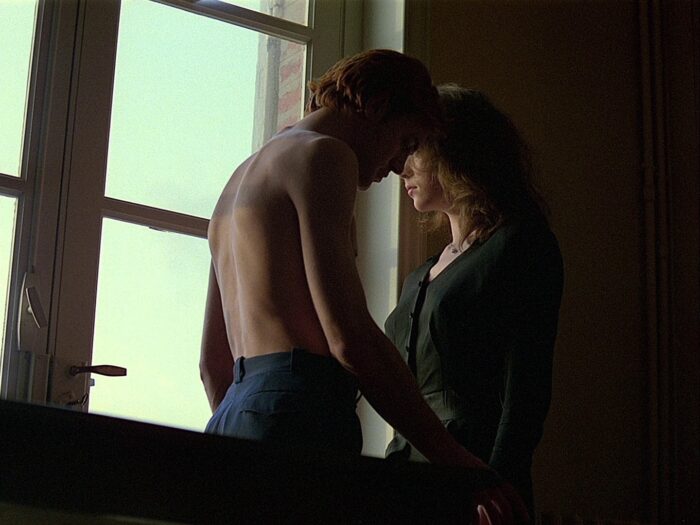
The year 1983 belonged to Carmen: Carlos Saura was making the flamenco film Carmen, and Francesco Rosi was preparing his opera film adaptation, which was completed the following year. Jean-Luc Godard’s version is – of course – something entirely different. Georges Bizet’s music is absent (apart from a couple of seconds of whistled melody), replaced instead by a string quartet rehearsing Beethoven. Godard turns himself into a caricature; he plays a film director who ends up in a mental institution.
Based on a screenplay by Godard’s wife Anne-Marie Miéville, the work disguises a bank robbery as the making of a film — or a film as a bank robbery. In this way, a constantly reversing mirror structure is created.
Even if the viewer is not entirely “in tune” with the film that won the Golden Lion at the Venice Film Festival, its treasure chest always contains something unforgettable: Raoul Coutard’s cinematography is dazzling, and the editing feels divine. Attention is drawn to the photogenic presence of Maruschka Detmers and Myriem Roussel. The male actors’ charisma has not received the same degree of attention.
Carmen is full of literary quotations, and recognizing them becomes a kind of game designed to measure the viewer’s “level.” The most beautiful and hopeful of these quotations come from Jean Giraudoux and Luis Buñuel — and Godard reserves this one for the ending of his work.
Veli-Matti Huhta