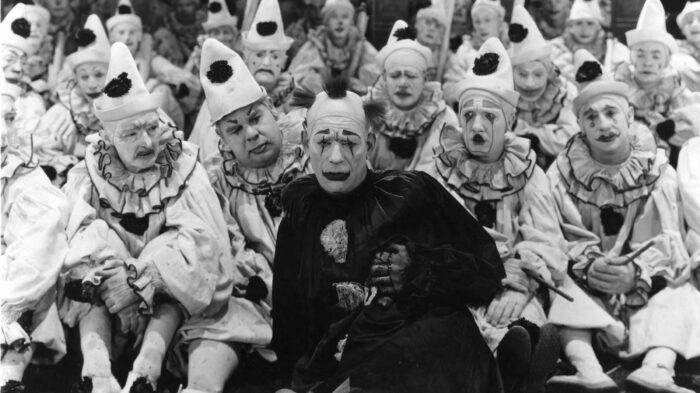
Russian author Leonid Andrejev’s 1915 play quickly gained a wide audience in both Moscow and on Broadway, and in Russia it was even adapted for the silver screen in 1916 – years before the Americanized Swedish master director Victor “Seastrom” Sjöström began working on his own film adaptation of the play. The story’s premise harkens back to timeless and tragic elements: the introverted scientist Paul Beaumont (Lon Chaney) works tirelessly on his radical theories and prepares to present his findings to the Academy, but his friend and patron, a wealthy baron (Mare McDermott), steals his work and presents it as his own with the help of Beaumont’s deceitful wife, Marie (Ruth King). This public humiliation culminates in a slap to the face.
The trauma of being made a laughingstock drives the man to a life as a circus performer, and – five years later – he becomes famous for his sadomasochistic clown act: night after night, he takes repeated blows to the face – to the sound of laughter from the audience. Beaumont falls in love with the beautiful Consuelo (Norma Shearer), whose bankrupt father (Tully Marshall) plans to marry off his daughter to the treacherous baron. However, the woman’s heart belongs to another – the handsome horseman Bezanol (John Gilbert); Consuelo even mistakes the clown’s sincere admission of love as a joke. Spurned once more, the reject plans to stop the arranged marriage by any means necessary…
He Who Gets Slapped found success both in the box office and among critics, and the careers of Sjöström, Gilbert, and Shearer gained some well-deserved traction. But at the painful heart of the film is the harrowing agony stemming from countless betrayals and disappointments, portrayed masterfully in the multifaceted performance of Lon Chaney, “the man of a thousand faces.” It is Chaney’s performance that takes this amalgamation of ancient Greek tragedy and modern psychological thriller into horror territory. The man’s stiffened, forced smile and the private turmoil it contains, as well as the looming, indiscriminate violence of the coming climax both contain elements reminiscent of Victor Hugo’s The Man Who Laughs as well as Batman’s Joker. Furthermore, the film also features the first appearance of the then-brand-new Metro-Goldwyn-Mayer production company’s legendary lion and his roar, and, what’s more, the feline beast also takes part in the brutality that ensues in the gruesome final minutes.
But the streams of emotion pool around Chaney’s virtuosic interpretation. Beaumont takes heavy blows not only in the academic field, but also on a societal level as he is continuously trampled on by the wealthier social strata, and in friendships, as well as – twice – in love. Thrust into the deep end, the scientist Beaumont can almost be interpreted as a “1920s Travis Bickle,” and as per usual for the elevated subgenre of circus (melo)drama, the sawdust is soaked with blood.
Sjöström’s wisely and skillfully directed, harrowing and authentic masterpiece tugs on the audience’s heartstrings, backed by the Italian quartet Agnusdei + Cavina + Pilia + Raia, whose music blends electronic elements with an electric guitar and a saxophone. Together, they carry the emotional, existential axe blows of fate conceived more than a century ago directly into our increasingly circus-like present.
Lauri Timonen