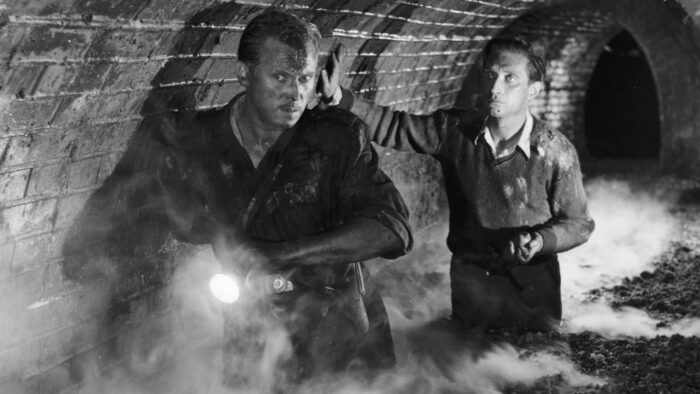
Master director Andrzej Wajda’s (1926-2016) 1950’s war trilogy came to mark the international breakthrough of Polish cinema. Between A Generation (1954) and the landmark Ashes and Diamonds (1958), he made Kanal, a portrayal of the uprising of German-occupied Warsaw in the autumn of 1944.
Driven into a desperate situation, a group of resistance fighters attempts to escape through the labyrinth of sewers beneath the city. The days of military honor culminate in hours of damnation amid filthy water and noxious fumes.
For Finnish viewers, an obvious point of comparison is another great war film, Edwin Laine’s The Unknown Soldier, which was completed only a few years earlier. The two works share something in their exploration of group dynamics, but there is also a crucial difference. While Laine’s tragedy plays out against the backdrop of nature, Wajda sets his film behind the facade of culture’s beautiful, futile vanities. There is a carefully groomed Adonis, a composer playing fragments of Chopin, and of course Dante, whose inferno is echoed by the curving sewer tunnels. There is even young love. Is it precisely because of this — because of European culture — that the claustrophobia of Kanal feels so monumental, and the devastation it depicts so absolute?
Veli-Matti Huhta