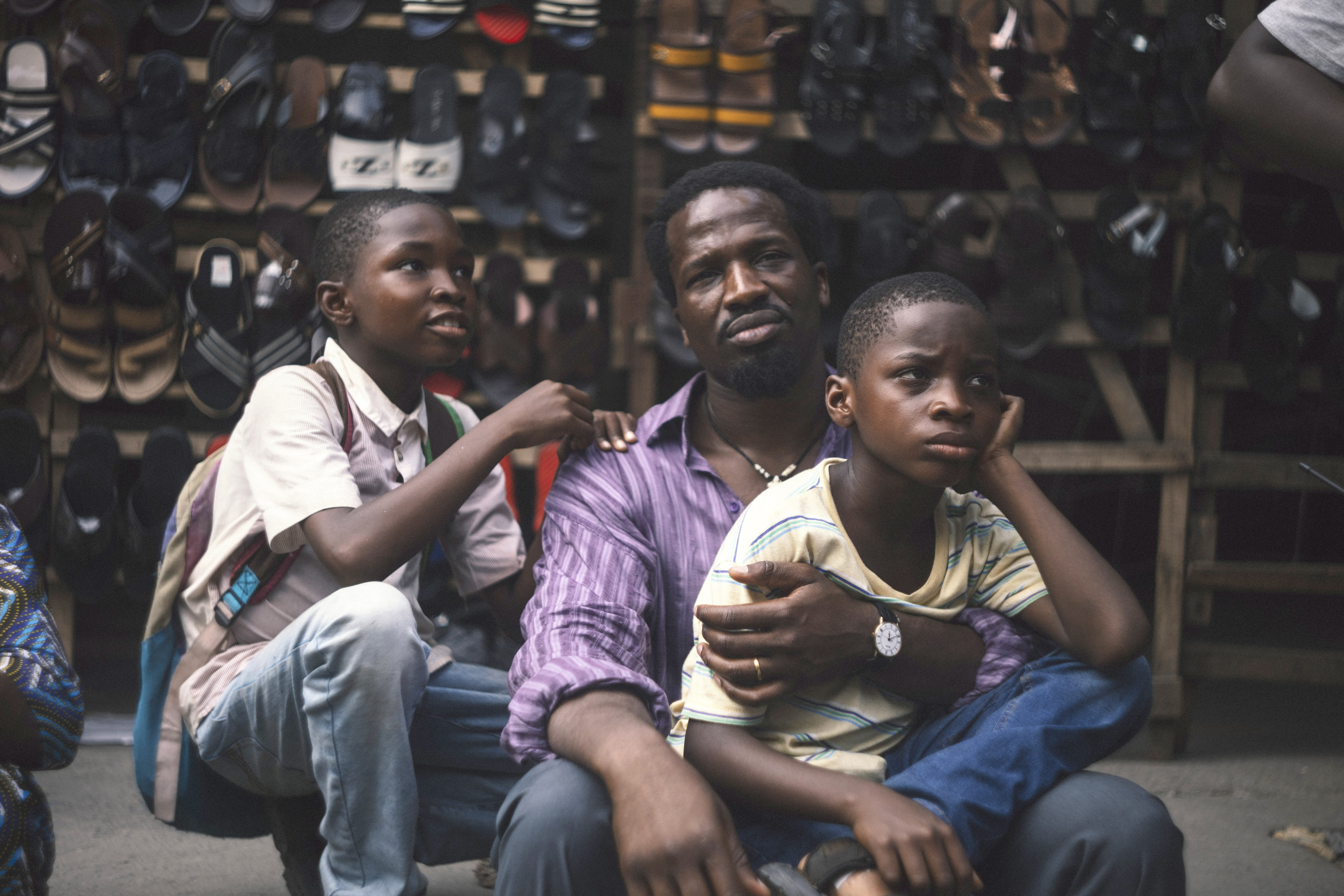
Nigerian cinema finally arrives at the Midnight Sun Film Festival! Akinola Davies Jr.’s My Father’s Shadow, one of last year’s most promising debut features, doesn’t represent the massive “Nollywood” output that rivals Hollywood and Bollywood, but is instead a Nigerian–Irish–British co-production.
Set on 12 June 1993, the film depicts the Nigerian presidential elections, which many hoped would see M. K. O. Abiola end military rule. Davies and his brother Wale Davies (the co-writer) vividly recount their childhood memories of travelling from the countryside to the capital, Lagos, with their politically active father. Regarding the choice of perspective, Davies has stated that, growing up, he loved watching children’s shows like Sesame Street and the Muppets—and because of their influence wanted to make dreamlike, “supernaturalistic” drama.
My Father’s Shadow is more about family ties and the dreams and shortcomings associated with them than it is about politics or history. On the other hand, both are about betrayal, contrasted with the theme of brotherhood. The brothers are played by captivating young lads, while Sobé Dìrísù, as the father, makes a real impact with his charisma. The individual motifs that linger in the mind from this film, which concludes with the documentation of an ecstatic martyr’s funeral, include a bridge, water, a shore, a carousel, blood, ravens…
AKINOLA DAVIES JR. (b. 1985) was born in London, moved away from Nigeria in his early teens and received his film education in New York. Before his debut feature, he made several mostly British and/or Nigerian TV movies, commercials and short films. Among them, Lizard (2020), which won the award for best short film at the Sundance Festival, has also been shown on television in Finland. Drawing on Davies’ childhood, the film depicts a young girl’s unsettling experiences during church services in Lagos. Themes of community, race, spirituality, identity and gender are central to Davies’ work.
Timo Malmi