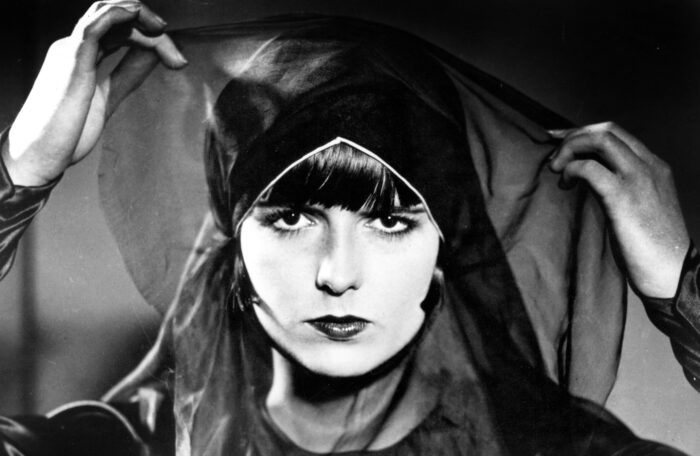
Pandora’s Box was not a sensation upon its initial release. The film, based on two plays by Frank Wedekind, was only properly rediscovered in the 1950s. Directed by G.W. Pabst and representing the genre of ”street films” and sinful salon dramas, it may lose out in visual virtuosity to the wilder visions of contemporaries Lang, Murnau or von Sternberg, but its decadent plot twists captivate even the modern viewer in its enjoyably gruesome and depraved grip.
The film centers around the young, beautiful Lulu (Louise Brooks), who weaves a sexual web entangling sugar daddies, abusers and innocent youths, complete with controversial lesbotic undertones, which caused quite a stir at the time. Lulu’s path leads her from the glitz of the variety stage to the angst of the courtroom, accusations of murder, exile and finally into the arms of a notorious serial killer. The mythological background of this pattern of sexual and homicidal lust is explained midway through the script by a prosecutor: ”The Greek gods created a woman – Pandora. She was beautiful and charming and versed in the art of flattery. But the gods also gave her a box containing all the evils of the world. The heedless woman opened the box, and all evil was loosed upon us.”
It is mainly the performance of the American Brooks that elevates Pandora’s Box into a masterpiece. Its genius lies in not situating Lulu as a thoroughly evil, calculating succubus but a woman baffled by her almost inherent vice of erotic magnetism. While she does drive men to ruin like the Medusas and Gorgons of film noir, she simultaneously foreshadows the sexually liberated hippie girls of the late 1960s. From this perspective, Lulu is perhaps a shade more innocent than Lola Lola (Marlene Dietrich) of von Sternberg’s The Blue Angel (1930) or many of Greta Garbo’s staple characters, where the languid indifference is intertwined with self-destruction caused by the malady of melancholia.
Lulu and Lola Lola do have another cultural connection: Dietrich was the second choice to play Lulu. And there have been several hybrid tributes of the characters since, such as Jacques Demy’s and Rainer Werner Fassbinder’s Lola renditions in 1961 and 1981. Asta Nielsen portrayed Lulu in an earlier film in 1921.
A woman who revealed herself to be a high-class intellectual through her spectacular memoir Lulu in Hollywood (1974/1982), Brooks knew exactly what she was doing. At times Lulu is like a ”piece of meat tossed into a zoo cage” (Wedekind), but in her final moments conjures up an entirely different register, as the mistletoe hanging above her head resembles – to quote Peter von Bagh – ”the halo of a saint”. The religious allegory is completed by the chilling connotations of the Christmas parade of the Salvation Army in the film’s conclusion.
The screening of Pandora’s Box will be accompanied by pianist Maud Nelissen and multi-instrumentalist Eduardo Raon playing classical harp and providing the electronic effects. The duo have stated they aim to produce a musical version of the film’s ”enigmatic chiaroscuro effect”, ranging between dazzling lights and darkest shadows.
Lauri Timonen