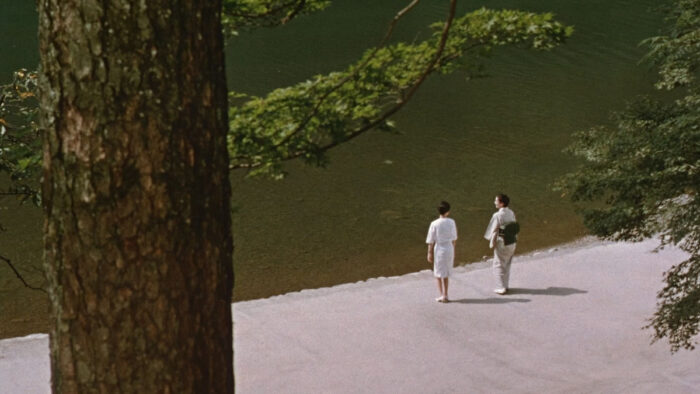
The second-to-last film by Yasujirō Ozu demonstrates the master’s ability to renew himself without having to compromise too much on his style or the central themes of his work. As in many of Ozu’s other classics, the narrative revolves around arranged marriages, the small joys of everyday life, and the sorrow of their fleeting nature. The film’s Japanese title would translate directly as The Autumn of the Kohayagawa Family.
The brewery owner Manbei, brilliantly portrayed by Ganjirō Nakamura, is a mischievous patriarch whose mortality nevertheless casts shadows over the story. We remain constantly aware that an era is soon coming to an end, and at the same time it is impossible not to think of the family patriarch as a kind of kindred spirit and alter ego of the director himself. Thus, while watching the film, we are also conscious that Ozu will soon be leaving us.
Among Ozu’s films, The End of Summer is perhaps the most emotionally multifaceted in atmosphere, with an emotional spectrum and gallery of characters so varied that they possess an almost extravagant richness. Its final scenes are among the most visually arresting pieces of storytelling in the entire canon of Japanese cinema. The film was also the director’s last collaboration with his regular star Setsuko Hara, and her presence brings to a moving close the continuum that began with Late Spring, a body of work reflecting on modern Japanese womanhood.
Topi E. Timonen