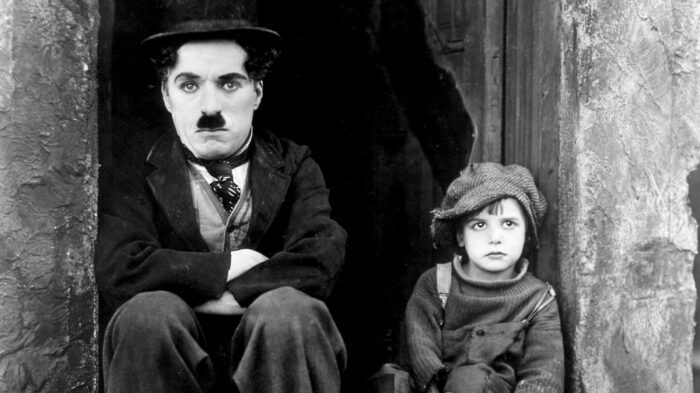
Charlie Chaplin’s first directorial feature is essentially a series of tragicomic events. In the beginning, an unwed mother (Edna Purviance) abandons her child because of adverse circumstances, and the infant ends up in the tender care of a poor tramp. Five years later, the little scamp, John (Jackie Coogan) is already assisiting his foster father in a semi-criminal window-repairing enterprise by breaking them in advance. He’s also schooled in the basic art of streetfighting in a rather free-spirited manner. Meanwhile, the mother comes into fortune, the boy falls ill and is kidnapped into an orphanage from which he eventually escapes. The abandoned Charlie falls asleep on his doorestep, seeing a surreal dream of angels and devils, but ultimately…well, let’s not spoil it.
This ruggedly sweet male pietà rendition is by no means the first story of its kind. Nowadays, it is almost a prototype for a subgenre, without which King Vidor’s The Champ (1931), Vittorio De Sica’s Bicycle Thief (Ladri di biciclette, 1948) or Astrid Lindgren’s Rasmus på luffen (1956) might have turned out quite different. Even Jerry Lewis imitated it several times during his directorial career, even though his estranged former partner Dean Martin mocked the admittedly syrupy and flimsy results less cordially as ”Chaplin shit”.
It’s often true that when a smart-alecky budding scholar wants to be intentionally critical and use a genius to batter another one (usually, in this case, Keaton), poor Charlie is often accused of being too sentimental. Meanwhile, Buster is implied to be the epitome of cool and macho because he doesn’t ”piss in our tear ducts” and maintains his bronsonesque laconic composure. But despite its melodramatic tendencies, The Kid keeps its tight form in check and offers at least five pranks and eight gags in exchange for every tear shed. The man and the child are not pathetic victims of circum- and happenstance but street-smart and resourceful anarchists always up for a scrap, who are equally adept at frying pancakes as getting one over on the fuzz.
Still, there must be something seriously amiss in your soul if the scene with the cruel bureaucratic authorities forcing John into their car and the kid stretching his trembling hands desperately to reach for the tramp’s door symbolizing the the warmth and love of home doesn’t tug at your heartstrings in any way. It’s no wonder that Coogan’s sublime portrayal has been touted as one of the finest child actor performances (perhaps of all time), and even in moments of mirth the chemistry between the senior and junior rogue is in a finely crafted balance.
In Sodankylä, this early Chaplin masterpiece is accompanied by the Dutch pianist, silent film specialist and a recurring guest in the North Maud Nelissen, who has been granted an exceptional honour by the Chaplin estate: she is the only musician who has received permission to perform the film’s music as a piano solo.
Lauri Timonen
THE KID Copyright © Roy Export S.A.S.
Music for THE KID Copyright © Roy Export Company Ltd. and Bourne Co.
Composed by Charles Chaplin. Arrangement Maud Nelissen.