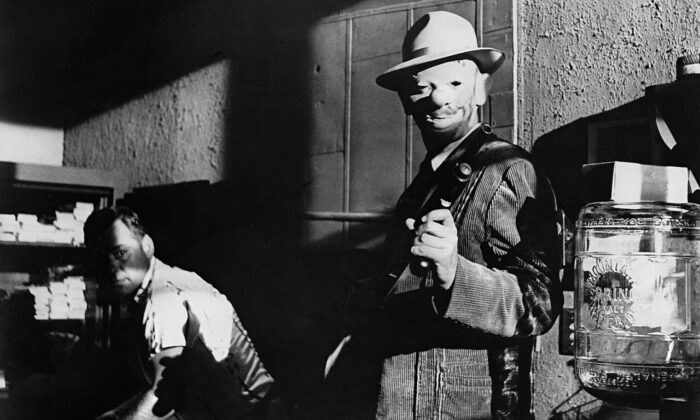
Stanley Kubrick’s first major masterpiece proved to be the revisionist film noir, The Killing. Ingeniously utilizing multiple perspectives, non-linear storytelling and repetition of events, the film is a masterclass in tension, driven by an unyielding ticking clock from start to finish.
In this hard-boiled crime drama, the leader of a heist crew Johnny Clay (Sterling Hayden) orchestrates a precision-timed robbery of a race track’s betting proceeds. However, the plan takes a left turn due to unfortunate coincidences and the schemes of a teller’s unfaithful spouse Sherry (Marie Windsor). This paragon of the thriller genre, which brilliantly employs the voiceover narration Kubrick so loved, unravels the knots of the criminal plot through stunning black-and-white cinematography, archival footage and an impressive score.
Standing as a worthy contemporary to John Huston’s The Asphalt Jungle (1950), the commanding Hayden as the gang boss is supported by a cavalcade of character actor roles, ranging from career criminals to a wrestler and from policemen to a femme fatale. In the background, the film reflects American societal attitudes towards ex-convicts and African Americans. The optimism of planning the perfect crime shifts to the pessimism of its execution, proving the whole thing can be brought down by a single human error. With The Killing, Kubrick cemented his place as a master of cynical noir, instantly raising him to the ranks of Huston and Robert Aldrich.
Tuomo Marttila