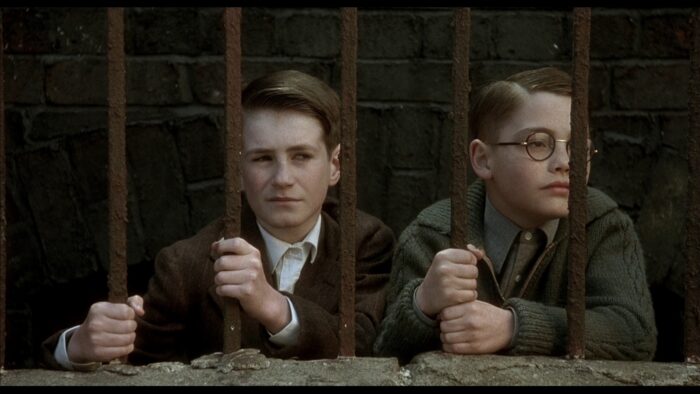
Terence Davies’ – who visited Lapland in 2010 – intimate mosaic of childhood memories is set in mid-1950’s Liverpool and within the modest daydreams of English families returning from the whirlpools of the Second World War. The 12-year old protagonist (Leigh McCormack) lives under the tender care of his mother and siblings, struggling his way “with the serene melancholy of a renaissance angel” (as per critic Michael Koresky) through a labyrinth formed by the social challenges of school, the horrors of church, his burgeoning sexual orientation, and a fantasy world complemented by trips to the movie theater.
The director focuses on fragmentary, sensory-rich visions, creating a Proustian musical out of fragments of melody – although the movie is not a musical in the strict sense. He masterfully squeezes every ounce of production value out of his modest budget. The intentionally static shots have a touch of Theó Angelópoulos and more than a hint of Wes Anderson, but the full prowess of Davies’ visual virtuosity is demonstrated in the finale’s spellbinding montage of sliding overhead shots, which juxtaposes and connects the film’s central locations. Davies’ tableau of growing pains stands out among other works of the genre through its melancholy and reflective undertone, pondering insecurity, identity shaped by experience, and the fragments of happiness eroded by time.
Lauri Timonen