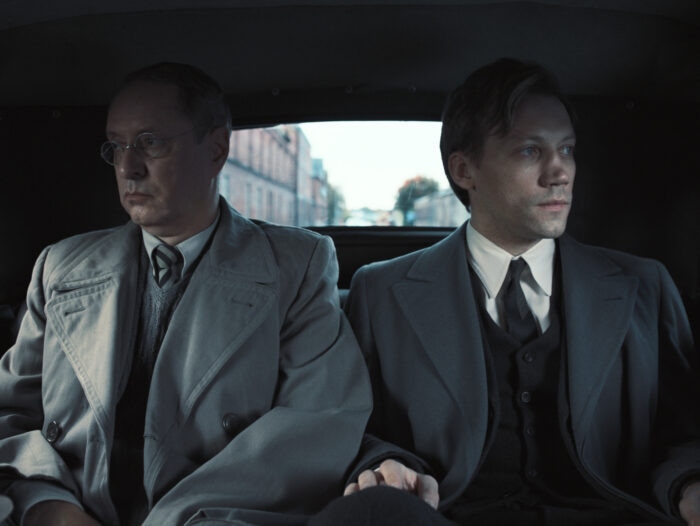
Those who thought that the high period of persecution in late 1930s Soviet Union might as well already be consigned to cinematic history are wrong: Sergei Loznitsa’s masterfully laconic and, regardless of its subject, aesthetically enjoyable vision of the nightmarishness of the era has far-reaching resonance – up to the Kafkaesque present of a Russia led by another tyrant.
Shot in Latvia, Two Prosecutors is familiar fare from Loznitsa: as in his famed documentaries, he now approaches this time in fiction – an adaptation of a novella by Georgy Demidov – the political history of the former Soviet territories with chilling sobriety. The setting is Bryansk, some 400 kilometers southwest of Moscow, the year 1937, with Stalin’s terror at its terrifying height. The young, idealistic prosecutor Kornev comes to meet a prisoner who is accusing the secret police NKVD of corruption. But Kornev himself, inside the machine as it were, will also get to feel the ruthlessness of the “justice” system.
In the brown-grey, static images captured (in the cramped aspect ratio of 4:3) by Romanian virtuoso cinematographer Oleg Mutu, Loznitsa keeps showing liberty-depriving doors, as if as metaphorical of surreal arbitrariness. In a stroke of genius, the protagonist Kornev is a Communist with trust in the Soviet system. His return trip to meet the Procurator General serves as the final eye-opener, at the very latest in the short finale. But what precedes it is a brilliant setup, forcing the viewer to dread some kind of a bad, almost absurd turn of events.
SERGEI LOZNITSA (b. 1964), who spent his school days in Kyiv, Ukraine, visited our festival three years ago, chiefly due to his world-famous documentaries (the most recent one of which then was The Natural History of Destruction, 2022). With Two Prosecutors he returns – as promised back then – to his equally excellent fiction features. Born in Belarus, Loznitsa completed his multidisciplinary studies in Moscow, from where he moved in 2000 to Berlin and more recently to Vilnius. Loznitsa’s highly internationally funded productions from the last 30 years include 20 feature films and a good dozen short films, mostly dealing with historical and/or social subjects.
Timo Malmi