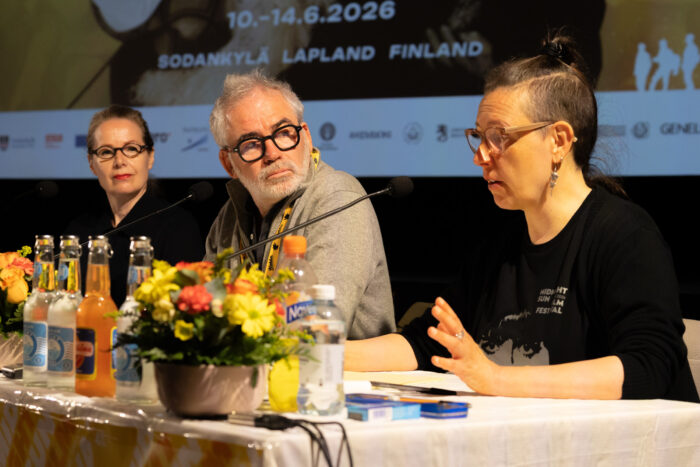
In Friday morning’s discussion, director-screenwriter Stephané Brizé talked about his personal history, family relationships and social awareness.
Brizé describes his own family background as modest. His father worked as a postman and his mother was a housewife with five children. “We lacked words and feelings; my family’s life was scarce in that respect too. I come from a world where we lower our gaze. When we saw better-off people on television, my mother said that this was not for us.”
Brizé says that as a child he admired the work of French actor Louis de Funès. Funès’s expressive acting, which borrowed its visual language from clownery, was the only thing that made Brizé’s mother laugh. Brizé began his working life in electrical engineering. He studied electrical engineering for two years, until he got an internship at a television company, where he ended up writing sketches for a children’s programme. When Brizé moved to Paris and started taking theater classes, the career change led to a rift with his family.
“My family couldn’t understand that I wanted to leave a secure profession. It would have been easier for them to understand if I had wanted to go to the moon than the fact that I wanted to pursue an artistic career.”
In his father’s mind, Brizé would end up as an alcoholic, a drug addict, and unemployed. He didn’t speak to his son for seven years. Their contact was re-established when Brizé wrote his father a letter, to which he replied in simple but beautiful words. Brizé then wanted to screen his first short film in Rennes, western France, so that his father could see his own surname on the big screen. Before the screening, however, Brizé received a phone call, telling him that his father had died. Thus, his father never got to see a single film directed by his son.
Brizé deals with difficult family relationships in many of his works. According to him, deep fear is often hidden beneath people’s harsh exteriors.
“I think my father’s seven years of silence were not out of malice or a judgment. He was terribly afraid that his child would fall back into the poverty and misery from which he himself had escaped.”
The gruff father figure in the film Not Here to Be Loved (2005) resembles Brizé’s grandfather. Brizé had unknowingly written a scene into the film that repeated his grandfather’s ways. In the film, after the death of a distant father figure, it is revealed that he had kept his children’s tennis trophies in a locked cupboard. After seeing the film, Brizé’s uncle had told him that Brizé’s grandfather had a locked chest of drawers in which he had secretly stored his children’s school certificates.
Brizé is known as a maker of social films through his trilogy about working life, but it took him a long time to find his own political voice. Politics were not discussed at home; it was a topic that was kept quiet about. “The film The Measure of a Man” was important to me; for that I needed certainty and faith that I could talk about politics, deal with political issues.”
Brizé talks about his working method, saying that the film always speaks to him already during the working phase. It takes patience to listen to it. “Even though I know where the goal is, I don’t always know how to get there, the route map is not clear.”
The question of which film he would take with him to a deserted island is an easy one for Brizé: Ingmar Bergman‘s Scenes from a Marriage. When he first saw the film, Brizé says he was not yet familiar with art films, but he says he noticed that Bergman understood something about film, that Brizé himself would like to pursue. “In my own humble way, I set out towards it, and I am still on that path.”
Picture: Urho Högman / MSFF