The second day of the festival began with a morning discussion, where director, screenwriter and producer Susan Seidelman talked about her path as a filmmaker. Seidelman’s career began at a time when female characters in films were mostly wives and girlfriends. However, Seidelman wanted to make films that depict restlessness and outsideness, and that feature strong female characters. She spoke about the influence of her youth in New York on creativity as well as reinventing herself as a recurring theme in her films.
At the same time, the Red Tent was warming up with Markus Lehmusruusu‘s unique sci-fi film Orava. The dystopian film takes a sideways glance at man’s compulsive need for control, while at the same time acknowledging man’s smallness in relation to his basic needs and the laws of the world.
At noon, people in Lapinsuu were impressed by Abderrahmane Sissako‘s film Bamako (2006). The film’s symbolic trial uses absurd humor, rigorous argumentation, and universal language to bring the World Bank and the IMF to justice. The film is one of the most significant works of 21st-century African cinema, and it will not leave its viewer indifferent.
Meanwhile, in the Big Tent, curator Jon Wengström presented a stunning selection of treasures that spanned film genres from beginning to end. The Swedish Film Institute’s archives hold a wealth of fine early European short films that have not survived anywhere else. This included, for example, the restoration of a hand-colored copy of perhaps the world’s first erotic film, Le Coucher de la Mariée (1896), based on a cabaret show. British pioneer J.H. Martin‘s versatility was represented by the slapstick comedy Short-Sighted Sammy (1905), restored from nitrate copies, and the fierce serial killer thriller The Fatal Hand (1907). Perhaps the biggest impression on the audience was made by Segundo de Chomón‘s diabolical trick film Les Flammes Diaboliques (1907), which closed the screening, in which a magician in a devilish costume conjures his assistant out of fire. The performance was accompanied by Maud Nelissen on piano.
In the afternoon, a panel discussion was held at Kitisen Keitaa; Film and All Other Arts. For example, the connection between literature, architecture and music and film was discussed by musician Marjo Leinonen, architect Hannu Salmi and bookseller and publisher Hannu Paloviita. The panel was moderated by journalist Iida Siimes. The discussants approached the issue, for example, with ways in which art can act as memory. Film can present architecture that no longer exists or has ever existed, and it can bring dead musicians, such as Elvis Presley, Aretha Franklin and Freddie Mercury, to life. Only literature has similar abilities to deal with the past, but the relationship between literature and film is not simple, and for example, film adaptations of books often lose the readers’ experience of the text. On the other hand, a film can be an image of the film maker’s interpretation of the text or a part of it, such as Jonathan Glazer‘s Under the Skin (2013).
Around the same time in the afternoon, the Red Tent was hosting the Song of the Most Beautiful Finland. The film, which warmly depicts a father-son relationship, made the audience laugh out loud. After the film, director Juho Kärkkäinen explained what the film is about for him, namely that love is the most important thing in the world.
The Red Tent hosted Finnish short film premieres in the early evening. In Mari Mantela‘s After Ego, 80-year-old brothers go on a mental and physical border crossing at the border of their property, led by a land surveyor. Pia Andell‘s Ei pilata juhlia puhumalla kuolemasta brings familiar characters from the short film Kesken (2024) to spend time together in a villa landscape. Even though summer is at its most beautiful, they do not arrive there free from worries. In Teemu Niki‘s Placeholder, a new platform economy service offers lonely people experience and practice in human relationships with the help of a placeholder, but at the same time the service employee’s own place in life is in danger of becoming blurred. Before the screening, the producers were given flowers, and after the screening Andell and Mantela, who were present, answered questions from the audience.
Around six o’clock, the festival’s first Silent Film Concert took place in the Big Tent: Charlie Chaplin‘s first full-length film Chaplin’s Son. The charming tramp and resourceful little boy’s inventive journey was accompanied by Dutch pianist Maud Nelissen. The cheerful century-old classic still provokes laughter.
In Lapinsuu, director Stéphane Brizé answered questions from the audience after the screening of Another World (2021). Brizé said that he is interested in examining dysfunctional systems, such as family and working life, in his art. The final part of the working life trilogy, Another World (2021), deals with a factory manager who realizes how wrong his work has turned out. Most of the performers in the film are not professional actors. Brizé considers it important that the lawyers in the film are played by professional lawyers and the factory workers by real workers. According to him, a person’s profession instills a certain way of speaking, as well as a body language that is difficult to imitate.
At the Red Tent, Gabe Klinger, director of Isabel (2026), and lead actress Marina Person – who will also be visiting the festival as director of Califórnia (2015), which will be screened on Friday – answered questions from the audience. The filmmakers talked, among other things, about their collaboration and their own relationship with the neighborhoods of São Paulo depicted in the film. Klinger hinted at the film’s connections to Aki Kaurismäki‘s Drifting Clouds (1996). Perhaps we will hear more about this in Klinger’s Sunday morning discussion.
At the same time, the atmosphere in the crowded Big Tent was at its peak when Finnish rhythm & blues legend Marjo Leinonen stepped in front of the screen, ready to sing Elvis Presley’s greatest hits. However, the rhythm of the Baz Luhrmann documentary that was shown had a twist: at the beginning the songs are kept to short segments, while Elvis’ archive interviews take up more time. Leinonen reminded us, with a twinkle in her eye, that the segments start with the opening of the voice. In the studio shot, Elvis tried out a few evergreens, such as the Beatles‘ Yesterday. When the film switched to the concert footage of Elvis’s Las Vegas season, the audience enthusiastically joined in That’s All Right (Mama) – which is also Leinonen’s favorite song. The audience’s joy was palpable, as the meticulously restored footage and the music as well as good sound gave the best possible picture of how fast-paced and entertaining Elvis’ shows were at their best.
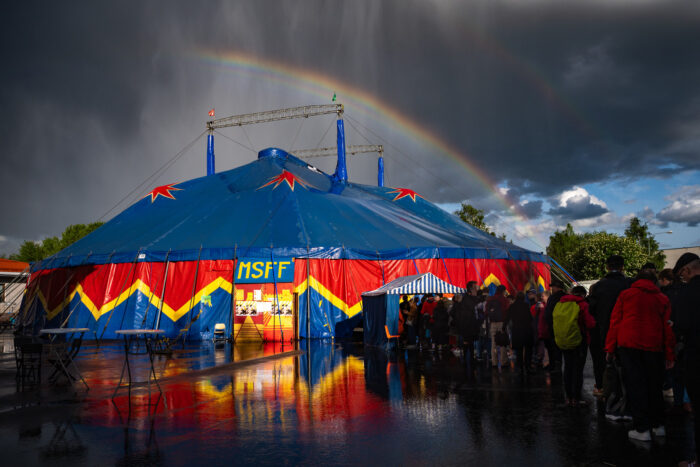
The rainbows that formed above the school on Thursday night perhaps predicted the late-night Master Class, as Olaf Möller introduced the Spanish musical Diferente (1962), directed by Luis María Delgado, to the audience. The film, full of fast-paced dance numbers, has been described as Spain’s first unequivocally queer film, even though it was produced during the years of Francisco Franco’s fascist regime. The life story of the son of a wealthy family who leads an artistic life, played by actor-dancer-choreographer Alfredo Alaria, is full of more or less subtle references that, for one reason or another, did not fall into the hands of the censors.
And so the second day of the festival descended into the light of a nightless night in all the colors of the rainbow – from the silence of silent films to the joy of Elvis karaoke, from trick films from a century ago to the questions of tomorrow. Fortunately, the midnight sun does not set, and that’s okay: the silver screen will glow again tomorrow.
Pictures: Taika Marttinen / MSFF