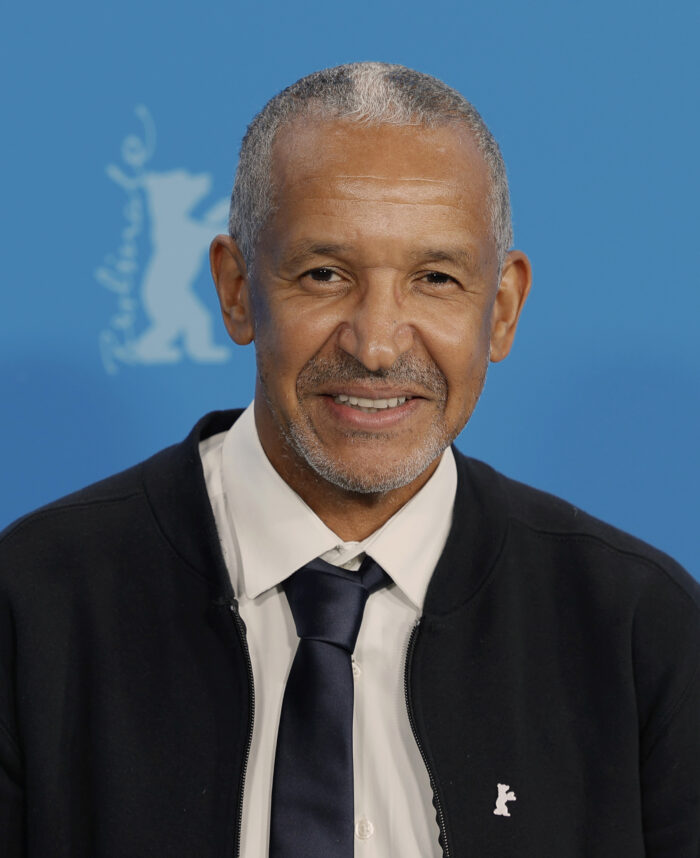
Subsaharan Africa has thus far been sadly, even shamefully underrepresented at our festival. But now, director Abderrahmane Sissako’s visit to our festival signifies another eminent addition to our already illustrious roster of Subsaharan guests, which so far has included the likes of Burkinabè director Idrissa Ouédraogo (who attended our festival in 1989), Malian director Souleymane Cissé (2011), and Chadian director Mahamat-Saleh Haroun (2018). Sissako, who was born in Mauritania but raised in Mali, is perhaps the most renowned African director of the 2000’s.
Sissako directed his first short film, the student work The Game (1989) in Moscow, and has since then been able to make only four feature-length African films (one of which is only an hour long), in addition to a Taiwanese co-production, Black Tea (2024). But the quartet screened at our festival is the real deal, from Life on Earth (1998), an originally made-for-TV film centered around the turn of the millennium, to the acclaimed Timbuktu (2014), which tackles the jihadism that plagues Western and Central Africa. The latter is a truly unique case in African cinema: the film not only earned Sissako an Oscar nomination for Best Foreign Language Film, but an astonishing seven wins at the Césars (France’s answer to the Oscars) – including Best Film and Best Director, making Sissako the first Black African filmmaker to win either award.
The morning discussion with Sissako will surely be exceptionally fascinating to hear: How was he born in his mother’s homeland of Mauritania, but raised in his father’s homeland of Mali? How did he, following the example of his mother’s eldest son, end up studying film directing, thus spending around ten years in the USSR as the Union was circling the drain, before later moving to Paris?
In 2002, Sissako won the International Federation of Film Critics (FIPRESCI) award for the film Waiting for Happiness, after which the film was asked to be screened at the New York Film Festival. But the film was never screened there: like Finnish director Aki Kaurismäki, Sissako was boycotting the United States at the time due to the visa denial of Iranian filmmaker Abbas Kiarostami (who attended our festival in 2007).
The conflicts of French West Africa as well as those between North and South play a prominent part in Sissako’s work, but he is no didactic preacher on a soapbox. Instead, with a loving and humane hand, Sissako places his focus on his characters, amid the wealth of African customs and traditions. On the other hand, even a Western viewer needs no special background knowledge in order to enjoy his films, in which the plot and dialogue are not central. Sissako places his trust in his painterly imagery and the poetic quality of his narration, as well as in music and humor.
When I first saw Abderrahmane Sissako’s feature-length debut Life on Earth nearly 30 years ago, I was distantly reminded of the films of Jacques Tati and Georgian-French director Otar Iosseliani. But Sissako’s influences are surely diverse, and in most of his films, closer to Africa.
Timo Malmi