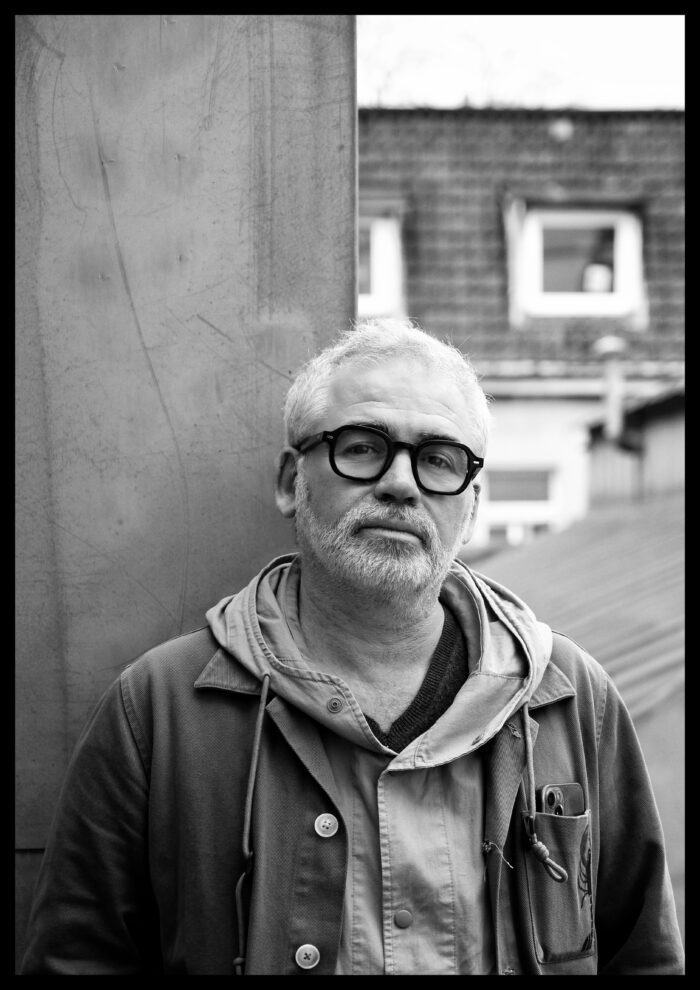
Stéphane Brizé is among those few writer-directors whose films have been regularly screened in the prestigious main competitions of the Cannes and Venice film festivals. His films have received glowing reviews, and he’s won numerous awards for his work. The adaptation of Éric Holder’s novel Mademoiselle Chambon (2009) received the César Award for Best Adapted Screenplay, while A Woman’s Life (2016), based on Guy de Maupassant’s novel, was awarded the renowned Louis Delluc prize, which is presented by a jury of film critics for a film combining artistic ambition, originality of style and a singular vision.
And one must not forget Brizé’s trusted leading man Vincent Lindon, who won both the Cannes and César for Best Actor prize for his role in The Measure of a Man (2015), in which his unemployed protagonist has to find work as a supermarket security guard and is driven to ethically conflicting situations as he monitors his co-workers and customers struggling with scarcity.
At the core of Brizé’s films is the human being – both the individual and the community – squeezed between social and cultural structures, societal power dynamics, and the faceless mechanisms of bureaucracy and the market economy. We walk alongside the protagonists through life’s major and minor turning points: surviving the financial, social and structural violence of working life (The Measure of a Man) and fighting for jobs (At War, 2018). We’re present in moments of letting go (Not Here to Be Loved, 2005) and the emptiness born from fatigue and crises of life choices (Out of Season, 2023). Chacun son combat – to each their own battle. The emotional spectrum of his films spans from anger to silent acceptance, from happiness to sorrow – from high drama to the comedy of the absurd in everyday life.
Brizé’s films carry a sense of lived experience and a desire to understand the surrounding world more deeply. He’s noted in interviews that his strength lies in precise observation and the way his fiction is fed by real-life events. Life and a shared sense of humanity are at the heart of everything, regardless of his aesthetic approach – be it sometimes captured with a hand-held, hectic and documentary-style camera diving into heated events or the understated tight square aspect ratio of a period film, focusing on the face and gestures of the protagonist trapped in their own illusions. Brizé favours restraint over sentimentality – sometimes even a laconic statement of fact and narrative ellipses – which, in extreme human situations, create powerful, unforgettable scenes.
When asked about the relationship between film and reality, Brizé has responded: ”I cannot change the world, but I can illuminate it. I am only a small flashlight. I feel the world is a better place thanks to the films of Ken Loach and Aki Kaurismäki. Fiction is cathartic: it can condense events which are scattered and diluted across the media in daily life. When a film condenses events stretched over several months in reality into an hour and fifty minutes, it packs a punch for the audience even when the subject matter is familiar.”
For Brizé, filmmaking is about creating emotion. The story must be built in order to make that emotion come alive.
Satu Kyösola