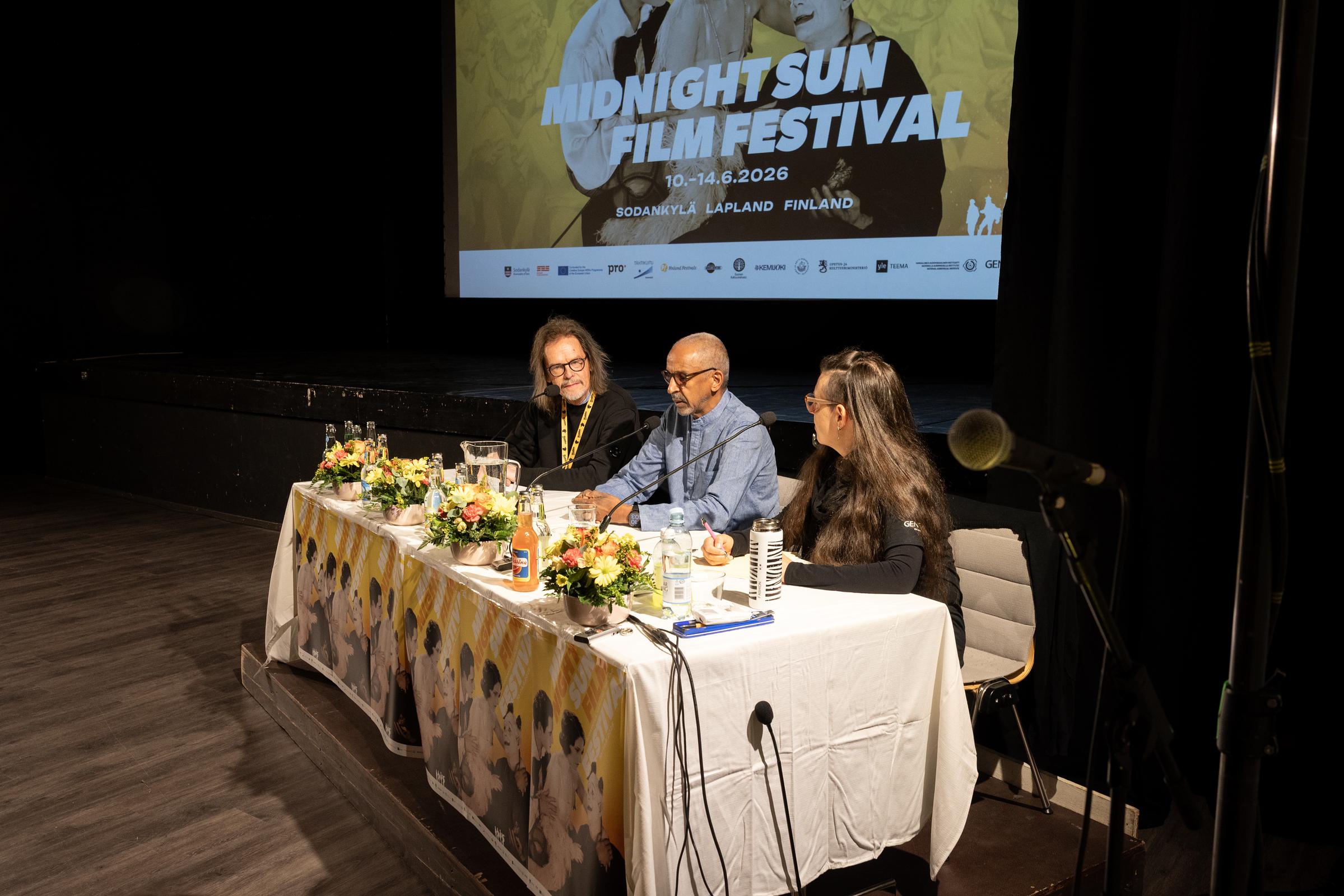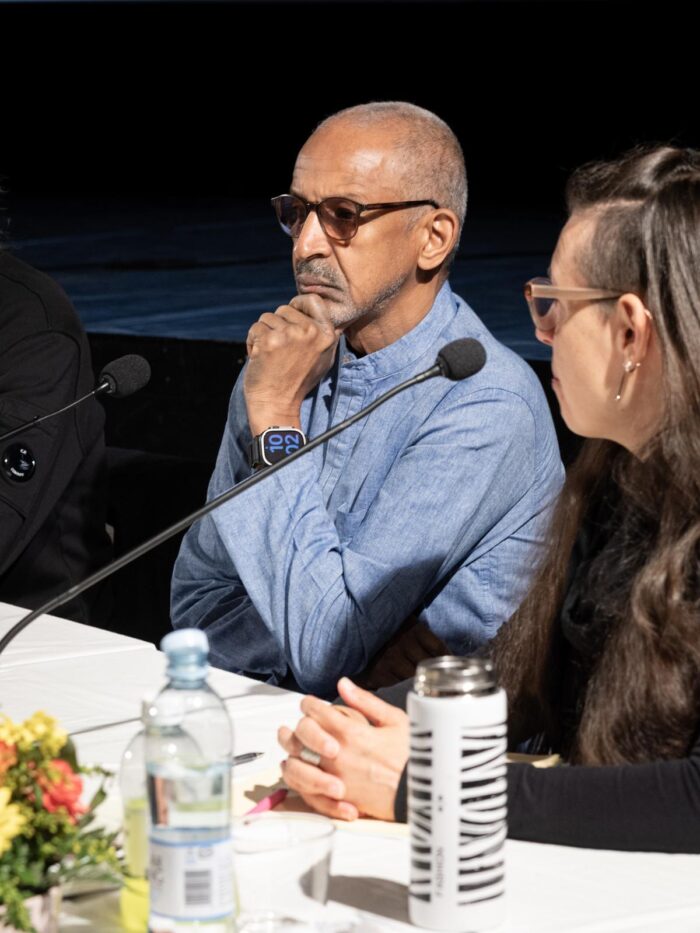
In Saturday’s morning discussion, director-screenwriter-producer Abderrahmane Sissako was interviewed by Timo Malmi at Kitisenranta School. Kaisa Kukkola acted as the interpreter for the discussion. Sissako told about how growing up in a large family, as well as the years spent at film school in Moscow, have shaped his way of looking at the world.
Sissako was born in Mauritania, but moved to neighboring Mali as a baby. As a child, the director had little contact with films, as there were no cinemas in Mali, and the family did not have a television either. Of the films he saw, he remembers Westerns in particular – from which he drew inspiration for the Western scene in Bamako (2006).
Sissako grew up in a family of 25, as his cousins also lived under the same roof. The impact of growing up in a large family is evident in Sissako’s films as a social and political aspect: “Living in such a large group somehow sharpened my own perspective on how I see and interpret the world.” At the heart of Sissako’s filmmaking is the desire to tell stories about the world around me, its horror and injustice.
Sissako’s journey to Mauretania as a teenager later inspired his film Waiting for Happiness (2002). A difficult year in Mauritania led Sissako to study filmmaking, by chance in Moscow, where he spent the next ten years of his life.
In Soviet-era Moscow, Sissako saw enormous hopelessness around him. In addition, Sissako was looked down upon in film school because of his African origin. He says that he learned to confront dismissive attitudes, and to dismiss them as the poverty of the human mind. Sissako also wanted to address this fear of difference in his films.
Nature is a central element in Sissako’s films. Eight years ago, Sissako bought 100 hectares of forest for nature conservation purposes. Sissako said that owning the forest has changed him as a person.
Above all, Sissako in this morning discussion emphasized the importance of human encounters and connections between people. He stressed that we must not turn a blind eye to the injustices and horrors of the world, such as the genocide in Gaza.
“Whenever hatred takes over, we are in great danger of losing touch with the humanity within us.”