The Saturday of this Festival of Nightless Nights was full of sun, hustle and bustle and the most unforgettable film experiences! The morning started with a very interesting discussion with one of the festival’s main guests, Abderrahmane Sissakko. At the same time, the Red Tent was filled with the documentary film The Beauty of Errors (2026) by Jukka Kärkkäinen.
At noon, Koulu screened Mr Puntila and His Servant Matti (1979), directed by Ralf Långbacka. At the beginning of the screening, The Midnight Sun Film Festival Artistic Director Timo Malmi said that Lasse Pöysti, who played the lead role in the film, had told him, back when he visited the festival as a film maker in 2008, that there would be a version of the film that would be about 15 minutes longer. According to Pöysti, the longer version contained beautiful landscapes, fog and night scenes. However, producer Anssi Mänttäri, who was present at the beginning of the film, denied the existence of such a lost, longer version. Arja Saijonmaa, who starred in the film, was also present and told the audience about her memories of the filming.
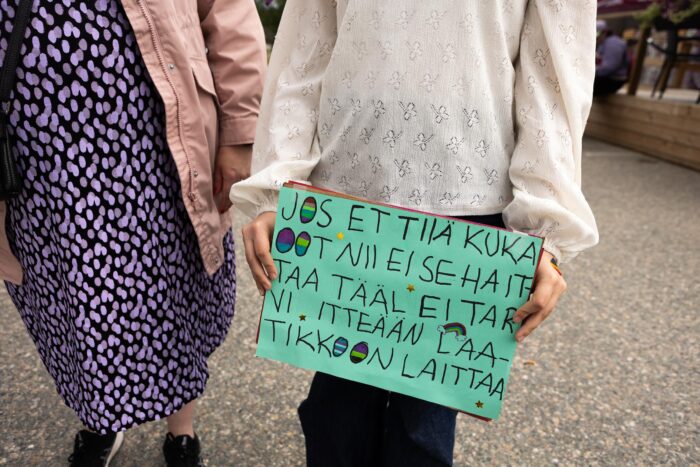
On Saturday afternoon, as the clouds gave way to the sun, the sports field began to fill with football players. The traditional El Clásico football match began to form with mixed teams, and the game started off with one team scoring a goal almost immediately. At the same time, the colorful Sodankylä Pride parade set off from the K-market yard. “Hey, hey, hey, Sodis is gay!” rang out around the village, and people joined in as the parade progressed towards the festival.
At noon in the Big Tent, German director İlker Çatak presented his film Yellow Letters, which won the Golden Bear at the Berlin Film Festival. The film follows the crisis of theatre makers in the grip of collapsing democracy and censorship. The film takes place in modern-day Turkey, but in a Brechtian way, German cities represent Turkish metropolises. Çatak spoke about how in this way he was able to simultaneously deal with the crisis of democracy in Germany and more generally. He praised the Turkish-born actors for being able to respond flexibly and calmly to changes, as a result of being accustomed to an unstable political situation. Çatak and Olaf Möller, who conducted the interview, disagreed on whether one film can change the world. However, they agreed that films provide new ideas and perspectives that can serve as seeds for change.
In the afternoon, Koulu hosted a Metamorphosis Masterclass put together by Jennifer Lynde Barker. The diverse selection of animations by female directors consisted of nine films from nine different countries. The ensemble celebrated the diversity of metamorphosis and animation. It examined how stories shape us and our understanding of the world. The characters in the animations, such as a little cat and a sleepless bear, elicited enthusiastic reactions from the audience.
In the afternoon, Isabel, directed by Gabe Klinger and co-written with lead actress Marina Person, was shown at the Red Tent. The film is about Isabel, a sommelier with a passion for natural wines and dreams of owning her own wine bar. After the screening, Klinger and Person talked about how quickly, and often improvising with strangers, the film was shot. One of the filming locations was Klinger’s own home, and in one scene, Isabel (Person) drags a refrigerator into the São Paulo subway, where the reactions of subway workers are filmed. “Remember, always film first without permission, and ask about it or say sorry afterwards,” encouraged Klinger, adding that he eventually contacted the subway; they enthusiastically decided to sponsor the film despite the secret filming.
At half past two, the stance of art was discussed at Kitisen Keidas, with the help of Finnish guest artists, in the discussion Artists Must Have a Backbone. The discussion, moderated by Liselott Forsman, included Yasmin Najjar, Pia Andell, Tommi Korpela, Aleksi Salmenperä, Jukka Kärkkäinen, Marko Talli and Arja Saijonmaa. In times when it may feel like ever darker news surrounds us from all sides, art at its best gives the individual the opportunity to structure their own place in this chaos.
At Kitisen Keidas, a panel discussion about Filmihullu‘s new paperbacks began at four: Sampsa Laurinen’s Jean-Luc Godard – Film History(s) and Mia Öhman’s edited Sex! The discussion included, Tytti Rantanen, Iida Simes, Aarni Pitkänen and Anssi Mänttäri. The Godard book is Sampsa Laurinen’s study of the contradictory combination of sounds, images and words in Jean-Luc Godard’s monumental film Histoire(s) du cinéma (1988–98) and how Godard‘s puzzle pieces could be connected. The Sex! paperback, edited by Mia Öhman, contains a selection of Filmihullu magazine’s texts on film eroticism from over the years and a few new articles, including Rantanen’s text on the Emmanuelle film series that caused a stir at the time, and one of the late Velipekka Makkonen’s last articles, on the films of Alan Guiraudie. The rest of the discussion was accompanied by Judge Nurmio, who was performing at the same time on the neighboring Yle car, but the background noise did not interfere with the discussion. As a final highlight, the chairman of the Risto Jarva Society, Ville Suhonen, presented an autographed photograph of Jean-Luc Godard from the society’s archives.
At six o’clock, the big tent was filled with the festival’s third and last silent film screening with live accompaniment, Pandora’s Box from 1929, directed by G. W. Pabst. According to the introduction by Timo Malmi, the artistic director of the film festival, it is a tragic story and a masterpiece. The first-class accompaniment of the performance was provided by pianist Maud Nelissen and multi-instrumentalist Eduardo Raon, who played classical harp and electronic effects in the performance.
A surprise Finnish preview premiere was revealed to the full hall of the School after eleven. The hall showed Erol Mintaş’s film Maan laulu (internationally known as Earth Song). This Kurdish-Finnish drama film had its world premiere at the Rotterdam Film Festival in January 2026, and will be released domestically in the fall of 2026. The film tells the story of a family living in Helsinki who has to face the truth in a variety of ways.
Saturday’s highlights also included the evening karaoke screening, which featured the joyful Priscilla – Queen of the Desert. The film’s opening singer was the sparkling Pola Ivanka, who incited the audience to sing and dance. The audience got into the film wholeheartedly and the Big Tent was filled with laughter and hilarious exclamations during the screening. The film culminated in Abba‘s timeless classic and laughter.
Curated by Mika Taanila, Minirusetti – Night School for Experimental Film, the audience fell into the hypnotic atmosphere of the early hours. In her introduction, Taanila said that she had also admired the work of Anneli Nygren, the director of the film Minirusetti (1978), on the pages of the cultural magazine Aloha!, where Nygren had a social circle column called “Anne Lee”. Nygren herself had made English subtitles for the children’s programme parody Minirusetti for the Sodankylä performance. In Objet d’enigme, directed by Chiara Caterina, 3D models of keys, doors, hands and twisted faces spin in a black void. The film played with clues to a murder mystery, without revealing any answers. The screening ended with Johann Lurf’s brand new work Forever…Forever, in which a camera left in place films the events in the Ottenstein storage tank without moving for almost two years. In the film, natural phenomena were transformed into sound, as Taanila describes it: “The movements of celestial bodies form the score in the film.” The essence of the Night School films moved between meditative, disturbing and restless. The school’s after-school session was organized in the traditional way on the shores of Kitinen.
Picture: Taika Marttinen / MSFF