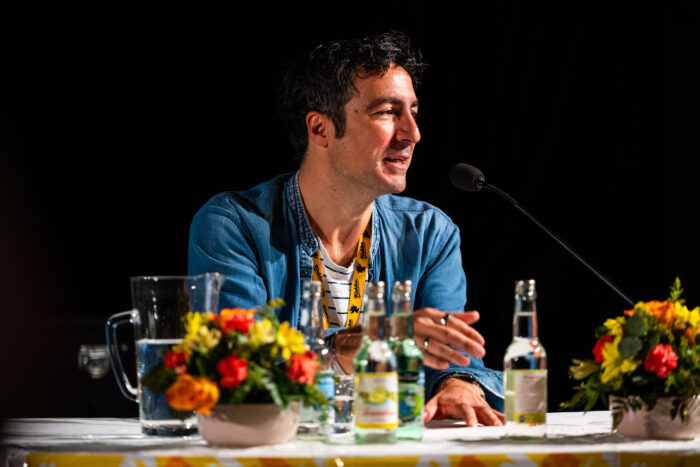
German director İlker Çatak (born 1984) has already by his early forties had a long career, with several award-winning works. The Teachers’ Room (Das Lehrerzimmer, 2023) was nominated for an Oscar for Best Foreign Language Film, and his most recent film Yellow Letters (Gelbe Briefe, 2026) won the Golden Bear at the Berlin Film Festival. The director recalled the beginning of his career in a morning discussion with Olaf Möller at Kitinen School on Sunday.
The first film Çatak remembered seeing was Harry and the Hendersons from the late 80s. The monster in the film was too scary for young Ilker, and he started crying when Bigfoot appeared. His father had to comfort him. “The experience was unsettling but fascinating,” Çatak recalls.
However, in his working-class childhood, he didn’t go to the movies very often. His interest in film only arose when he moved back to Turkey with his family as a teenager and met a friend who had a collection of DVDs.His family had high hopes for him, but he didn’t enjoy studying economics in Berlin. When his academic advisor asked him what he liked, he said that he only liked watching movies almost every day. “He said, straight out, that I should make movies.”
Çatak applied to become a production assistant and dropped out of school, which his family found difficult to understand. It wasn’t until he got attention for his short film When Namibia Was a City… (Namibya sehir iken…, 2010) about his father, whose own performance was also awarded, that they began to be proud of their son’s career.
Çatak couldn’t afford the most expensive film schools when he was young, so he accepted a place that was cheap, as long as he had access to a camera and other equipment. He paid for his education by running an ice cream stand, and later by doing commercials for odd companies, such as milking machine dealers. “I had a period of 10 years when I didn’t know if I could be anything,” Çatak recalls. “However, a time like this is very important, to learn what it’s like to fail.”
He got a lot of film ideas during that time, which became useful for him later. He was not, however, satisfied with his first feature film, the psychedelic coming-of-age story Once Upon a Time in Indian Country (Es war einmal Indianerland, 2017), because the film did not make money. “Every director wants to show what he can do – look world!”
Çatak considers the film I Was, I Am, I Will Be (Es gilt das gesprochene Wort, 2019), which was also screened in Sodankylä, to be his real debut, because it is a more personal story about young people with Kurdish backgrounds.
“Cinema is not dead, but you have to think about what kind of film makes people get up from their couches.” He set the audience to ponder the question of what cinema is. “For me, cinema is the space to say my mind (…) it is also a political playground,” he says, hinting that as the world situation becomes more dire, he feels a greater need for rebuttal or for giving space for questions.
Picture: Juho Liukkonen / MSFF