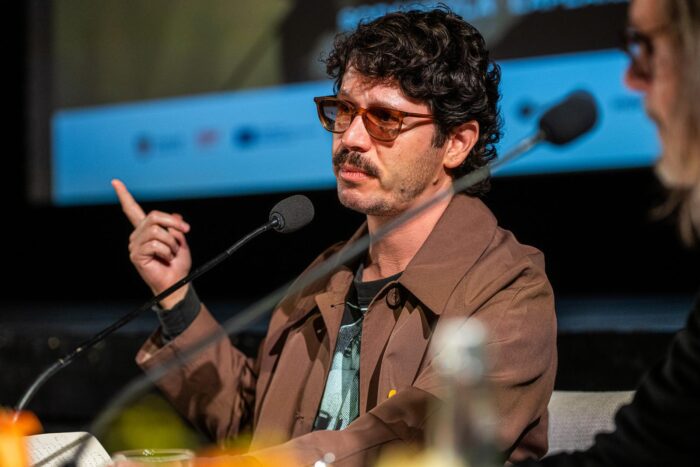
In Sunday’s second morning discussion, Gabe Klinger talked about his path from film critic to director-screenwriter. Klinger became a cinephile at a young age, influenced by his art critic father, writings about film, and of course, films.
Klinger said that the French New Wave filmmakers had paved the way for him to become a filmmaker. When he showed an excerpt from the café scene in Porto (2016), Klinger told an anecdote about one of his role models, Jean-Luc Godard. The scene features John Lee Hooker’s song Shake It Baby, the original version of which was too expensive for the café scene in Bande à part (1964). “I’m going to do what Godard wasn’t able to do” Klinger says he joked.
Klinger’s background is in film criticism, curation, and archives. As a young man, he was particularly interested in old films, although he also watched exploitation films of the time and American indie films. One of Klinger’s earliest film memories was the surprise he experienced after seeing his first black-and-white film. Something like this exists!
What motivated Klinger to become a film critic was a lack of money: writing about films allowed him to attend press screenings of films for free. Klinger, who lived in Chicago and Barcelona as a young man, frequently attended film festivals. This led to instructive discussions with film professionals.
Klinger also found his community at festivals. What he values most at festivals is the interaction with the audience. Klinger is not seen at events aimed at the film industry. “Who are we making films for, the industry or real audience?” he asked.
Archival veteran Klinger prefers traditional film to digital film technology. One reason is the preservation of film, but of course it is also a matter of aesthetics. In Porto, which is shown at the festival, different films are parallel to different levels of memory and ways of experiencing memory. Above all, however, film allows Klinger to have a conversation with the history of cinema.
Klinger’s films shown at this festival are strongly connected to their filming environments. The memories and levels of memory that Porto tells about are, according to Klinger, also strongly present in the streets of the city that exudes history.
Klinger discusses his own history in particular in his film Isabel (2026), which is also shown at the festival. In it, Klinger returns to his childhood hometown, which he sees with new eyes through the protagonist played by Marina Person. According to Klinger, the São Paulo depicted in the film is an idea of the city, a reflection of hopes for the city. Moving to Brazil has been a big transition for Klinger, and he does not yet feel that he is making a Brazilian film. “My passport is cinema, but I happen to be in Brazil,” he says.
Picture: Juho Liukkonen