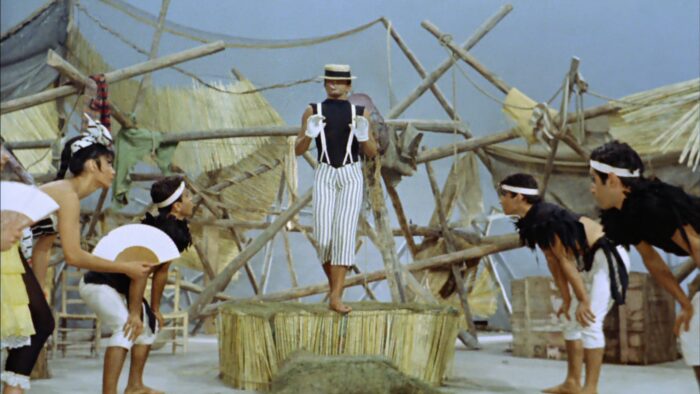
Is it due to contemporary film culture’s ugly obsession with realism that musicals in their carefree subversiveness – pain in pink to Pate carmine, joy in jonquil going Jordy blue – turned from staple cinema diet to a mostly welcomed film oddity? Or was the economy the culprit, as movies don’t sell records anymore? Or did music videos replace them, reduce them to crystallizations of movements in time? Or are musicals simply too complex and grand to stage for the post-studio world, which is to say too huge a risk to take? Consider this: The critical neglect of auteurs like Jon Murray Chu or John Carney (to include musical comedies as well) speaks volumes about the minds and souls writing about, showing, or simply loving films today.
The 60s were the last decade when musicals – or let’s say: musical cinema, was ubiquitous, also in smaller shapes and guises across the globe. And at sometimes quite unexpected places, like the German Democratic Republic whose musical culture was comparatively massive – on the screen as well as on stage. It might look odd that a state communist country would turn into a hotbed for an art commonly connected with the very capitalist US of A, but this case was particular: The established German traditions of musical cinema organized around singing and dancing had to be rejected for obvious historical reasons, while the modernism driving the finest musicals were awkwardly in line with the new state’s ideas about popular art. Matka aviovuoteeseen (Journey into the Nuptial Bed, 1966) by Joachim Hasler (whom some of you hopefully remember from Hot Summer, 1968, two years ago!), is one of the most astonishing musicals DEFA produced: madly colourful, sexually subversive, and almost dangerously anarchic in spirit! True grown-up stuff!
FRG sui generis genius Helmut Käutner’s Wirtschaftswunder-satire The Dream of Lieschen Mueller (1961), on the other hand, was a gigantic exception in a production culture where musical cinema meant either revue– or schlagerfilme directed at a brisk clip. Back in its days, The Dream of Lieschen Mueller was vilified by the local critical establishment old and young – by now, it is considered one of the most artistically daring works of the period. Similar things can be said about Spanish Diferente (1962), another solitary attempt at doing a Hollywood-style musical in a culture that had its home-grown variety of lyrical drama, the zarzuela. This stunner is also an unambiguously gay film by gay Argentinian actor-dancer-choreographer Alfredo Alaria (helped in technical matters by industry pro Luis María Delgado).
Italy and France, all the while, used the structure of pop music cinema for local musical experiments, with the former developing its own unique subgenre called musicarello, of which up and coming star autrice Lina Wertmüller created an all singing all dancing meta-satire with Don’t Sting the Mosquito (1967). The least dancing, finally, is provided by the equally meta-movie-mad Nouvelle Vague-spoofritic Find the Idol (1964), but as the secret handbook of film programming prescribes: thou shalt show a film by Michel Boisrond whenever even half an argument can be made for it. Amen to that, and laissez les bons temps rouler!
Olaf Möller