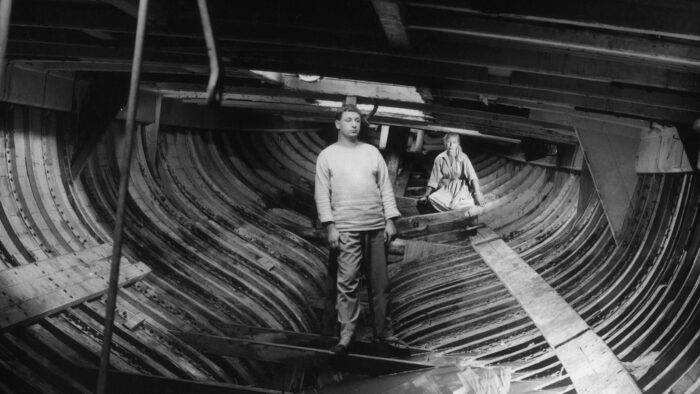
Organized in collaboration with the Archive Film Festival Network, The 1950s Early Works trains its sights on the early-career bullseyes of canonized master directors. Considering the fascinating moment that connects them – roughly the mid-1950s – it would be tempting to babble on about “new waves”, Agnès Varda’s La Pointe Courte (1955) being counted among the early starting signals for one such in France. It might be more sensible, however, to speak of national generational experiences – Stella (Michael Cacoyannis, 1955) and Kanał (Andrzej Wajda, 1957) were key works along the Greek and Polish cinema’s march to world fame – seeing as even the most famous of artistic movements are stylistically disparate, and the best achievements are almost always rooted in individual ideas instead of collective euphoria.
The seventh art has tended to remain turbulent even without any waves, and by the mid-1950s upheavals had been constant, from the arrival of sound, colour and television through two world wars to special formats such as the briefly popular 3D. Cinema in particular had to react to those modernist upheavals that had long been churning within literature, poetry, painting, sculpture, theatre, dance and music, where classical ways and structures of narration were being taken apart and put together again in more imaginative ways. Some directors found inspiration and/or a revolutionary spark in circles of like-minded colleagues, others such as Jacques Tati and Stanley Kubrick consistently created their entire oeuvres as lone wolves, outside of any trends and the cultural temptations of the Zeitgeist.
Varda borrowed the structure of two parallel storylines from Faulkner’s The Wild Palms (1939) and used it as a starting point for La Pointe Courte, insisting that she hadn’t seen those founding works of Italian neorealism which inevitably appeared to be the models for her sociological drama about the everyday goings-on of a fishing village. Wajda provided the Polish people – still recovering from wartime horrors – with a brutally therapeutic voice almost reminiscent of Väinö Linna, creating a subterranean, claustrophobic, Dantean Hell, letting the brink-of-madness protagonists of the pessimistic Kanał literally wade through the shit in the sewers. The Cyprus-born Michael Cacoyannis for his part helped Greek cinema reach world recognition with the ruggedly beautiful Stella, animated by the bold and touching lead performance of Melina Mercouri.
Kubrick’s The Killing (1956) is a sombre and brazenly cold classic of crime- and caper-cinema, something of a bastard sibling to Huston’s Asphalt Jungle (1950), including having Sterling Hayden in the lead. The most riotous laughs of the festival year are served by Les Vacances de Monsieur Hulot, Tati’s stockpile of ideas and gags, whose shoreline the waves beat as waves should – unfettered and free.
Lauri Timonen